The problem
Most SEO audits are snapshots taken too late. Crawlers run manually, issues are exported to spreadsheets, and regressions are discovered after rankings or traffic have already moved.
CrawlOps turns SEO monitoring into an always-on technical quality layer for product, engineering and SEO teams.
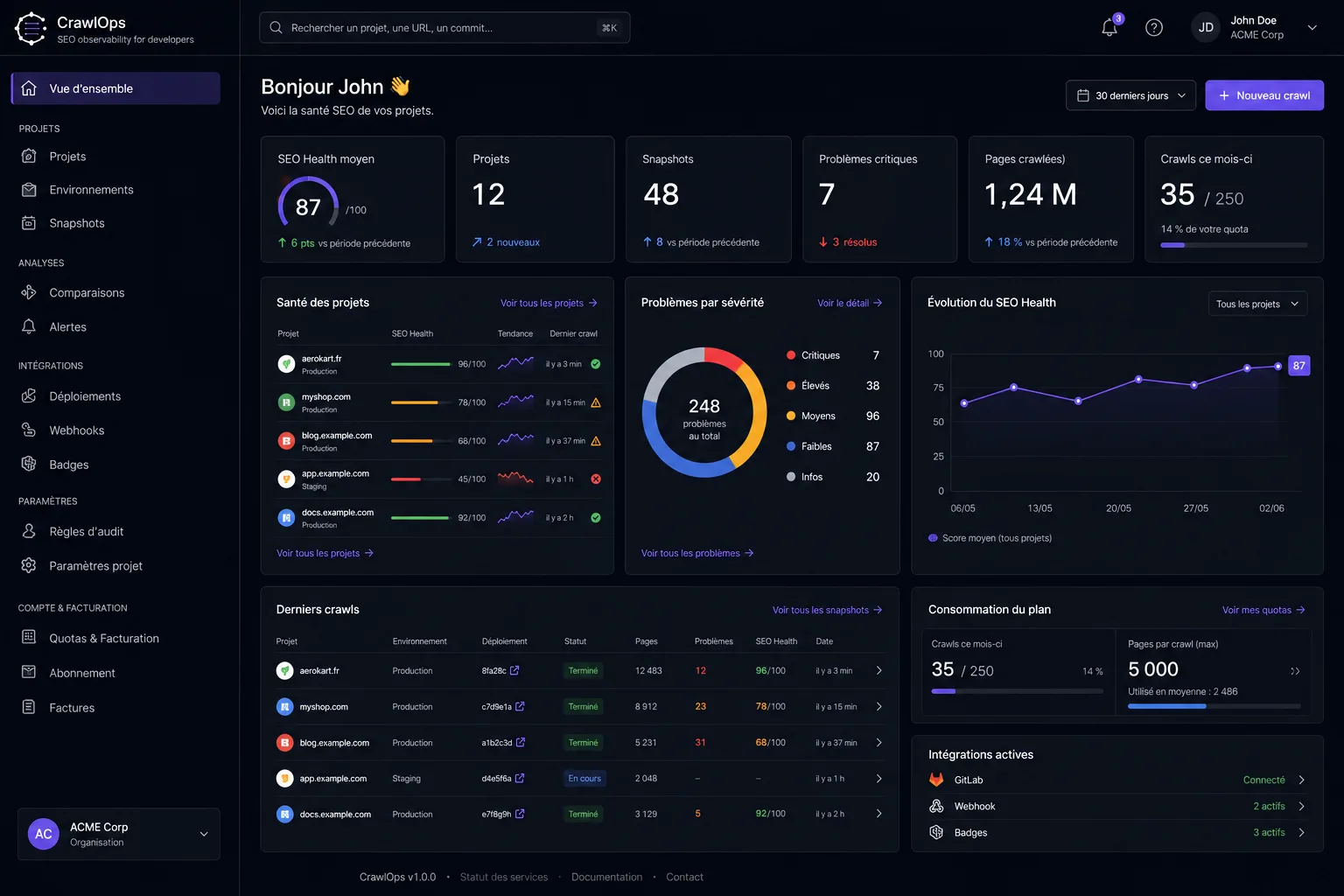
Most SEO audits are snapshots taken too late. Crawlers run manually, issues are exported to spreadsheets, and regressions are discovered after rankings or traffic have already moved.
CrawlOps creates crawl snapshots after deployments, compares them over time and highlights the issues that changed.
SEO monitoring is the practice of continuously watching the technical signals that influence how search engines crawl, understand and index a website. It is different from a one-time SEO audit. An audit tells you what was wrong at the moment it was run. SEO monitoring tells you what is changing, when it changed and which pages are affected. That difference matters because modern websites are not static documents. Product teams deploy new templates, developers change routing rules, CMS editors publish content, ecommerce teams update product catalogs, and infrastructure teams adjust caching, redirects or security headers. Any of those ordinary changes can create a technical SEO issue.
A strong SEO monitoring workflow tracks the signals search engines depend on before rankings are affected. It watches status codes, redirects, canonical tags, noindex directives, robots.txt rules, XML sitemaps, hreflang annotations, structured data, internal links, response times and crawl depth. These signals are not decorative. They influence discovery, consolidation, indexability, crawl efficiency and the way authority flows through the site. When one of them changes unexpectedly, the organic visibility of a page, template or entire section can be put at risk.
CrawlOps is built around this operational definition of SEO monitoring. It does not treat technical SEO as a quarterly export. It stores crawl snapshots, compares them over time and makes regressions visible with page-level context. The goal is simple: teams should know when important SEO signals change, understand why the change matters and have enough information to fix the issue quickly.
Most technical SEO problems are silent at first. A page can load perfectly in a browser while returning a poor status code to crawlers. A template can render beautiful content while shipping an accidental noindex directive. A canonical tag can point to the wrong URL after a release. A sitemap can keep listing removed URLs. A robots.txt rule can block an important section. These issues do not always create immediate visual errors, so they often escape normal QA. Search engines, however, read those signals directly. If they are wrong, the website can lose crawl coverage, indexation quality or ranking stability before anyone notices in analytics.
SEO monitoring helps teams move from reactive cleanup to proactive protection. Instead of waiting for a traffic drop, a Search Console warning or a manual audit, teams can detect changes close to the moment they happen. This is especially important for websites with frequent deployments, large inventories, international sections, faceted navigation, migrations, redesigns or multiple stakeholders editing content. The more moving parts a site has, the more valuable continuous SEO monitoring becomes.
For developers, SEO monitoring creates a feedback loop. They can see whether a deployment introduced a redirect chain, changed canonical behavior or caused pages to become unreachable. For technical SEO specialists, it creates historical context. They can compare snapshots and understand whether a problem is new, recurring or already present in the baseline. For agencies, SEO monitoring makes client reporting more defensible because recommendations are connected to crawl data and change history rather than isolated opinions.
CrawlOps focuses on technical SEO signals that can be measured, compared and explained. Each crawl creates a snapshot of the website at a specific point in time. That snapshot includes pages, links, HTTP status codes, titles, headings, canonicals, response metrics, sitemap information, robots.txt behavior and structured data markers. Because the snapshot is persisted, CrawlOps can compare it with a previous crawl and identify what changed.
This makes SEO monitoring more practical than a static checklist. A missing title is useful to know, but knowing that the title disappeared after the latest release is far more actionable. A noindex directive is important, but knowing whether it is new, limited to one URL or repeated across an entire template changes the priority. CrawlOps is designed to surface those distinctions. The product connects technical SEO data to projects, environments and deployments so teams can diagnose issues in the context of real website operations.
SEO auditing and SEO monitoring are complementary, but they are not the same workflow. A traditional audit is useful when you need a broad diagnosis, a strategy review or a baseline before a major project. It is often manual, periodic and report-driven. SEO monitoring is continuous, operational and change-driven. It asks a different question: what changed since the last known state, and does that change create risk?
This distinction is important for teams that ship frequently. A crawler export from last month cannot tell you whether yesterday’s deployment broke canonicals. A spreadsheet cannot explain whether a new 404 appeared after a route change. A static report cannot show whether SEO health is improving or deteriorating over several crawls. SEO monitoring fills that gap by turning repeated crawl data into a timeline of technical SEO health.
CrawlOps is intentionally positioned as an SEO monitoring layer, not only as a crawler. The crawler collects the data, but the product value comes from snapshots, comparisons, issue severity, deployment context and historical trends. That is what helps teams prioritize. Not every issue is equally urgent. A new critical regression on an indexable template matters more than an old warning on a low-value page. Monitoring makes that difference visible.
Many SEO regressions are introduced during normal releases. A frontend refactor changes markup. A routing update changes trailing slash behavior. A CMS template removes a canonical tag. A performance optimization alters response headers. A migration rule creates an extra redirect hop. None of these changes are necessarily “SEO tasks,” but each can affect organic visibility. That is why SEO monitoring belongs close to the deployment workflow.
CrawlOps can be triggered from CI/CD so a crawl runs after production deployment. The deployment metadata can include branch, commit, pipeline URL and author. When the crawl finishes, the resulting snapshot can be compared with the previous baseline. This creates a clear operational story: a release happened, a crawl measured the site, and CrawlOps identified whether SEO-critical signals changed. Teams can then investigate with the exact page, issue category and severity.
This approach makes SEO part of delivery quality without forcing developers to become SEO experts. Developers get actionable signals, not vague warnings. SEO teams get technical evidence, not guesswork. Product teams get a clearer view of release risk. Over time, this helps organizations treat organic search as part of the product surface rather than a separate channel that is reviewed only after problems appear.
SEO monitoring is valuable for any website where organic search matters and change is frequent. Ecommerce websites need it because product, category, faceted and discontinued URLs can change constantly. SaaS websites need it because marketing pages, documentation, pricing pages and product-led content are often updated by several teams. Agencies need it because they are responsible for multiple client websites and need reliable evidence when reporting issues. Developers need it because technical SEO regressions often originate in code or configuration changes.
The highest value use cases include website migrations, redesigns, international SEO, large-scale content operations, ecommerce template monitoring, CI/CD quality gates and ongoing technical SEO governance. In each case, the core problem is the same: the website changes faster than manual SEO review can keep up. SEO monitoring closes that gap by watching the technical layer continuously.
Free technical SEO tools are useful when you need to debug one URL. A redirect checker can confirm a redirect chain. A canonical checker can inspect the preferred URL. A robots.txt tester can explain whether a page is crawlable. A sitemap checker can validate XML structure. These checks are valuable because they make invisible signals visible. But they do not answer the monitoring question by themselves: is this happening across the site, and did it change recently?
CrawlOps connects individual checks to a larger monitoring workflow. The same technical concepts used by single-URL tools become part of full-site crawl snapshots. Instead of checking one canonical manually, CrawlOps can track canonical behavior across a project. Instead of checking one status code, it can monitor the distribution of statuses over time. Instead of validating one sitemap, it can compare sitemap URLs with crawled URLs and highlight drift. This is how SEO monitoring becomes scalable.
If you are starting with a single issue, use the free tools. If you need to protect a website over time, create a project and monitor it with CrawlOps. The difference is not just volume. It is memory. A monitoring platform remembers the previous state, detects changes and helps teams understand whether a technical SEO issue is new, repeated or resolved.
CrawlOps translates technical SEO checks into concrete issues tied to pages, environments and deployments. That makes SEO regressions easier to reproduce and fix.
Snapshots and comparisons show whether SEO health is improving or degrading over time, and which signals changed between crawls.
Continuous monitoring gives agencies a durable evidence layer for client reporting, migration validation and monthly technical SEO governance.
Monitor product, category, sitemap and internal linking changes before template-level issues affect thousands of URLs.
A one-time check can confirm a problem. Continuous SEO monitoring shows when the problem appeared, whether it is spreading and whether the fix actually resolved it. CrawlOps is built for that operational loop: crawl, snapshot, compare, prioritize and improve.